
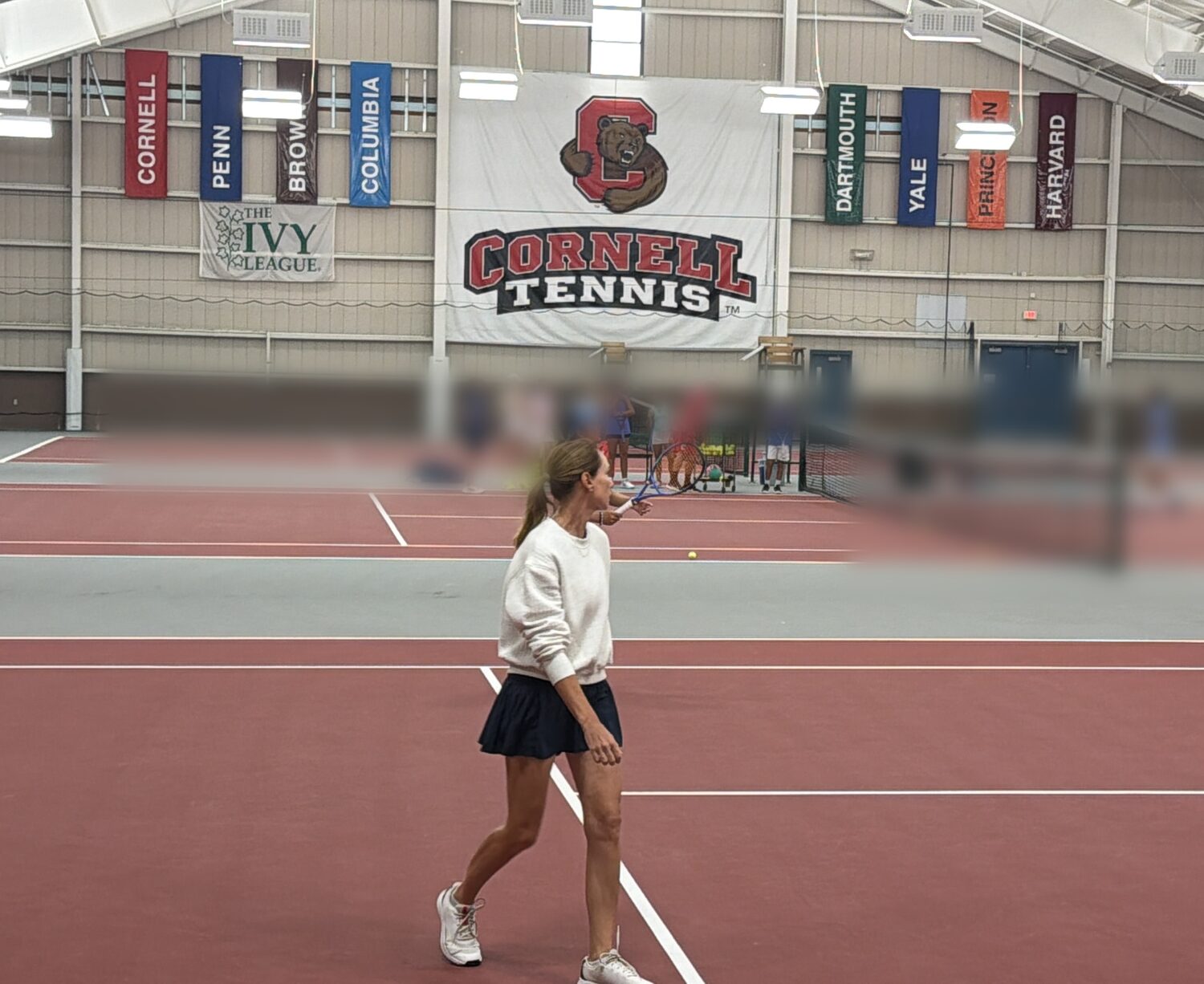
Guest Coaching at the Cornell University Tennis Camp: What I Saw This Summer
There's a moment I look for every time a young player steps onto the court to hit with me, and it has nothing to do with their forehand.
The camp this month at Cornell brought in juniors across a wide range of ages and levels, some just finding their game, some already competing hard. A few of them knew my background from the tour, and I noticed something when we hit together. When one of them ripped a clean winner past me, or stole a point they had no business winning, there was a little jolt. A bit more spine in the next ball. A bit more belief. That flicker is the thing I pay attention to, more than any single shot, because it shows me how a player responds the instant a moment starts to matter. And at these ages, you are watching it form in real time.
That is really what a week like this is about. Not turning anyone into a finished player, but noticing what is already there and giving it something to push against. The kids who stood out to me were not always the cleanest ball-strikers. They were the coachable ones. Focused, asking real questions, absorbing the answer instead of waiting for the next drill. Coachability is not something you bolt on later. It is either there or it is not, and when it is there, everything else has room to grow.
Here is what I find myself telling parents, whatever level their child is at. The strokes matter, but they matter less than people think. What lasts is whether a player learns to read a match, to adjust when an opponent takes their favorite shot away, and to hold themselves together when a set slips. That is not a stroke-mechanics problem. It is strategy, decision-making, and the mental game, and it is the work I love most, whether we are on the same court or breaking down match video from opposite sides of the world.
I also want to be honest about the bigger dream, because a lot of families carry it quietly. Some parents watch their child at a camp like this and wonder if one day they might play in college, maybe even somewhere like an Ivy League program. Some of these kids really are talented enough to dream about it. But that road asks for a great deal, on the court and off it, in the classroom as much as in training, over years and not over one strong week. I am not a college coach and I won't pretend to speak for how any program recruits. What I can say is that the qualities that carry a player there are the same ones worth building at eleven or fifteen: composure, competitiveness, coachability, and the willingness to do the quiet work when no one is watching. Chase those, and the rest stays possible.
Coaching alongside Silviu Tanasoiu and his staff at the Reis Tennis Center was a good reminder of how much care goes into developing young players, and it sharpens how I think about every junior I take on.
I am back for the second session, July 20 to 23, and I expect I will have more to share after that. If you are working through this stage with your own junior, at any level, the strategy, the in-match decisions, the mental side of competing, that is the work I do in one-on-one strategy sessions and match video review. You will find more on the coaching page.